
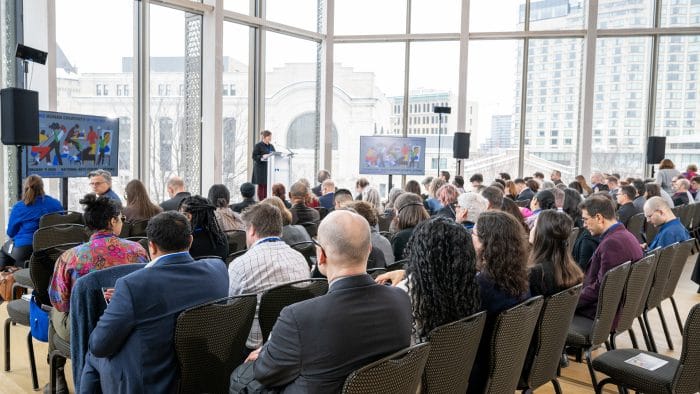
The rapid advancement of generative AI is bringing about significant changes in the world of arts and culture. So much so that Canadian Heritage has decided to organize a National Summit on Artificial Intelligence and Culture at the Banff Centre for the Arts on March 16 and 17.
In preparation for this important meeting, the Coalition for the Diversity of Cultural Expressions (CDEC), a Canada-wide organization of which Xn Québec is a member, organized the conference Valuing Human Creativity in the Age of AI.
The event, which took place at the National Arts Centre in Ottawa on February 11, sparked discussions on topics as varied as creativity, copyright, and the protection of culture in the age of generative AI.
Highlights from a day of constructive discussions.
Valuing Human Creativity in the Age of AI
Watch the conference on the CPAC.ca website
The Age of AI
To kick off the day, journalist and filmmaker Chloé Sondervorst provided an overview of generative AI and its impact on the creative industries. Using a series of examples drawn from recent news, she demonstrated the rise of AI as a cognitive, creative, and communications infrastructure.
Citing Taylor Owen, she argues that we should expect new social norms to emerge as a result of this new technology.
In the face of these changes, it is up to the various cultural organizations—much like the members of the Fellowship of the Ring as imagined by J.R.R. Tolkien, to demonstrate solidarity, complementarity, and a sense of adventure in order to “promote human creativity in the age of artificial intelligence.”
Artificial Intelligence and the Formula for Creativity
By definition, generative AI is not very creative.
This is the conclusion shared by David Cropley, a professor of engineering innovation at the University of Adelaide (Australia). His work, published here, is based on the following formula:
C = E × N
where C = Creativity; E = Effectiveness; N = Novelty
From this, the professor concludes that generative AI is limited to a very ordinary level of creativity. Indeed, since these tools operate by generating text, images, or videos based on statistical averages, they cannot think outside the box and simultaneously maximize both efficiency and novelty. On the contrary, they are constrained to produce results where effectiveness and novelty are balanced, thereby tending toward mediocrity.
Artificial Intelligence and the Publishing Industry
Comic book artist and illustrator Jean-Paul Eid, along with Félix Moreau, executive director of Éditions Québec Amérique, came to provide an update on the current state of the book industry.
As a founding member of the Regroupement pour l’art humain, Jean-Paul Eid points out that the major generative AI models were built using portfolios that were copied without the artists’ consent. He expressed optimism about the future, noting that both artists and the public view the use of generative artificial intelligence to replace the work of illustrators with disfavor.
Félix Moreau, for his part, explained that Québec Amérique has long been at the forefront of technological innovation, having published, among other things, 887, an augmented reality book by Robert Lepage. However, he believes that generative artificial intelligence undermines what his publishing house is striving to build: a human connection between a reader and an author. That is why he has no plans to use it in the future, whether for writing, translations, or illustrations.
Digital Sovereignty and Generative AI
Thomassie Mangiok and Natasha Ita MacDonald then took the stage to present the work of the Heritage Lab, an initiative aimed at preserving the Inuktitut language and Inuit culture through generative artificial intelligence tools.
Rather than using solutions developed by large international companies, Thomassie and Natasha opted for self-hosted applications and servers. “We don’t want outsiders to take over our culture, repackage it, and sell it back to us,” explains Natasha.
This argument in favor of digital sovereignty seemed to resonate with the audience.
The Law and Generative Artificial Intelligence
Christian Leblanc, an attorney and intellectual property partner at Fasken, then provided an overview of the case law criteria applicable to legal proceedings involving large artificial intelligence models.
From the outset, he stated that Canada’s current legislation is fully capable of regulating generative artificial intelligence. In his view, the fair use exception under Section 29 for research purposes would not authorize the reproduction of works to “train” commercial large language models (LLMs) such as ChatGPT.
Canadian courts will be called upon to rule on the matter, but already, in Germany, an initial ruling against OpenAI states that no copyright exception permits it.
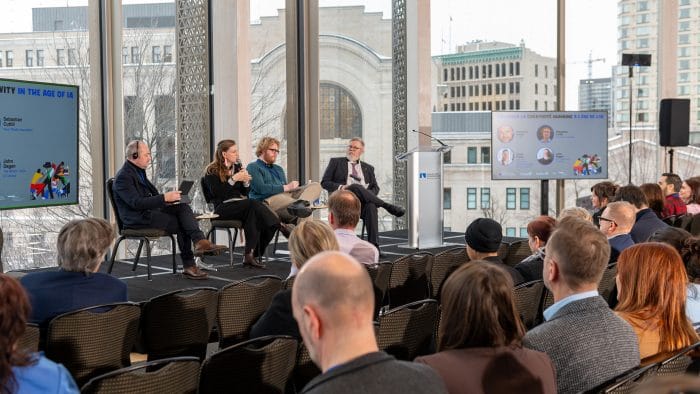
How to Regulate AI in the Arts: A Guide
If there’s one thing to take away from the panel “International Overview of Recent Developments in the Regulation of Generative AI in the Cultural Sector,” featuring Benjamin Bleton (Society of Authors, Composers, and Music Publishers), Sebastian Cuttill (News Media Association), and Claire Pullen (Australian Writers’ Guild Authorship Collecting Society), it is that a resistance movement is taking shape.
In France, Sacem has adopted a clear policy that limits the use of AI to that of a supplementary tool. A work can only be protected by copyright if it is created and signed by a human. Conversely, Sacem’s catalog cannot be used to train large language models (LLMs) unless a prior agreement is in place.
In the United Kingdom, following a mobilization driven by a major communications campaign, the ruling party was forced to back down on its proposal regarding the training of large language models. It is worth noting that Parliament had taken the position that all content could be used to train large language models unless rights holders objected (opt-out).
In Australia, a new law restricting access to social media to people aged 16 and older recently went into effect. This proves that the Big Tech companies can be regulated. Furthermore, Claire Pullen notes that organizations that are usually at odds with one another—such as the Australian Publishers Association and the Australian Writers’ Guild—have joined forces to support the Australian government’s decision to reject the inclusion of an exception for text and data harvesting in its legislation.
Toward a UNESCO Protocol?
To conclude the day, Destiny Tchéhouali, a professor of international communication in the Department of Social and Public Communication at the University of Quebec in Montreal (UQAM), called for the adoption of an additional protocol to the 2005 UNESCO Convention on the Protection and Promotion of the Diversity of Cultural Expressions.
This additional framework would go beyond a mere declaration of intent and would apply to digital spaces. Among other things, it would require AI systems to respect copyright principles and ensure transparency in their operations.
Undoubtedly, this proposal, supported by the CDEC, will be part of the discussions at the National Summit on Artificial Intelligence and Culture on March 16 and 17.
Photo credit: Dany Lepage/CDEC.
This text was translated from the original French with the help of DeepL.