
A few weeks ago, we published an article on the representation (or rather, unfortunately, in most cases, the lack of representation!) of diversity within digital experiences. As a follow-up, we wanted to explore the challenges of universal accessibility to digital experiences, challenges that cannot leave any digital producer indifferent today.
Access for all to our cultural and artistic offering is both a public necessity and a formidable tool for opening up to the widest possible range of audiences. While it’s not always easy to ensure that we meet all individual needs, it is possible, and easy, to put in place the basic elements to make our productions more accessible.
As the Canadian government reminds us in its rich Digital Accessibility Toolbox, there are four most common types of disability to which digital productions can be adapted: hearing impairment, visual impairment, cognitive impairment and mobility, flexibility and body structure.
Tools for the hearing impaired
With regard to hearing impairment, which concerns deaf and hard-of-hearing people as well as those with central auditory processing disorder (i.e. “difficulty hearing and understanding speech even if no measurable hearing loss exists”), several avenues are suggested. For example, video producers can ensure the provision of subtitling, sign language interpretation or transcription, and producers of in situ experiences can ensure the provision, in addition to audible alerts and signals, of visual alerts, which can take the form of lights that “flash, pulse, dim or turn on and off”. From the point of view of digital experience design, the toolkit’s authors also recommend the use of a “linear and logical layout”, the “segmentation of content with subtitles, images and videos” or the choice given to users to “choose their preferred means of communication” when interacting with services.
Recommendations for the visually impaired
The term “visually impaired” covers the blind and visually impaired, as well as people who are color-blind or have low vision. Here again, several recommendations are made by the authors to digital producers, including “the use of good color contrasts and legible font sizes”, “the use of a combination of colors, shapes and text”, or avoiding too much uniformity in the proposed designs, using for example “only color to convey information”. In addition, to go one step further, it is also possible to integrate adaptive technologies such as text-to-speech proposals.
Don’t forget cognitive differences
Cognitive disabilities include intellectual disabilities characterized by “significant limitations in both intellectual functioning and adaptive behavior”, as well as reading and dyslexia issues, mathematical and computer disabilities (which “impact on a person’s ability to learn and communicate mathematics”), attention deficit hyperactivity disorder (ADHD), non-verbal learning disabilities, and autism spectrum disorders. In particular, the latter may present certain traits that can affect their access to digital technology, such as communication difficulties, i.e. “using and understanding language, making eye contact, giving unrelated answers to questions and repeating words and phrases over and over again”, as well as, among other characteristics, sensory sensitivities, i.e. “unusual reactions to the sound, smell, taste, appearance or feel of things”. Here again, the toolbox suggests simple actions that can be implemented within digital productions, such as, for example, the use of simple colors and sans-serif fonts, the use of “simple sentences and bulleted lists”, the “creation of descriptive buttons” or even “the construction of simple, coherent layouts”. It’s also possible to offer users a certain amount of control over colors and contrasts, or to favor audio and video media for interaction. Above all, it’s important not to overload users with information, and to avoid colloquial expressions wherever possible. And don’t forget to avoid “rushing users” or setting short deadlines for tasks.
How can we include people with mobility, flexibility and structural disabilities?
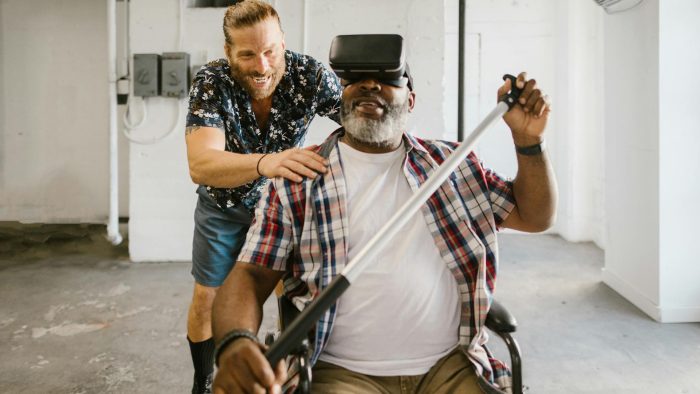
Finally, mobility, flexibility and body structure disabilities concern people with manual dexterity or fine motor control issues, ambulation issues (i.e. “the ability to walk from one place to another independently, with or without an assistive device”), muscle fatigue, but also cover disabilities of body size or shape. For them, the government toolbox recommends, among other things, the introduction of large clickable action zones, the development of interactions adapted to people using only the keyboard or voice, or the possibility of using shortcuts. In addition, it will obviously be important to adapt in situ digital experiences to enable universal access. To this end, the Quebec-based organization Kéroul can be of invaluable help to producers; with its mission of making culture accessible to people with restricted physical ability, it offers training and support to events and cultural offerings wishing to improve their accessibility.
Photo credit: RDNE Stock project
This text was translated from the original French with the help of DeepL.